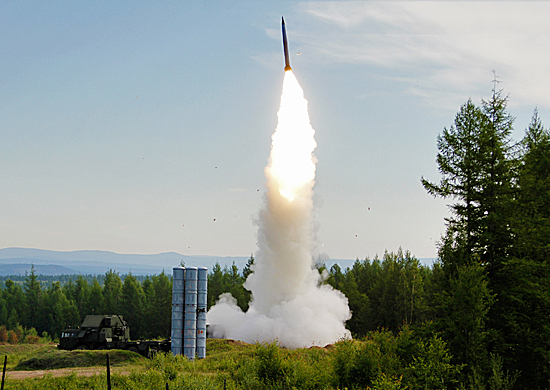
Russia’s Space Forces launched on Thursday a Soyuz-U carrier rocket with a Cosmos-series military satellite, SF spokesman Col. Alexey Zolotukhin said.
The rocket was launched from the Plesetsk space center in northern Russia.
“The launch has been carried out to expand the cluster of Russian military satellites in orbit,” Zolotukhin said.
The official did not provide details on the specific nature of the spacecraft but according to NASAspaceflight.com it could be a Kobalt-M spy satellite with advanced reconnaissance and terrain mapping capabilities.
In this capacity it will join Russia's Oko (Eye) orbital missile early warning network, which consists of about 70 satellites.
The Soyuz-U rocket is designed to orbit Soyuz and Progress manned and cargo spacecraft, as well as special-purpose satellites such as Cosmos, Resurs-F, Foton and Bion.
The Russian Air Force will receive the first batch of prototypes of its fifth-generation T-50 fighter for performance testing in 2013, Col. Gen. Alexander Zelin said on Thursday.
The T-50, developed under the PAK FA program (Future Aviation System for Tactical Air Force) at the Sukhoi experimental design bureau, is Russia's first new major warplane designed since the fall of the Soviet Union.
“The work on the fifth-generation fighter is going according to schedule,” Zelin, a former Air Force commander, told a news conference in Voronezh (central Russia). “The third prototype has joined the testing program and the fourth is being built.”
The T-50 made its maiden flight in January 2010 and three prototypes have since been undergoing flight tests.
Zelin earlier said that the number of T-50 aircraft involved in testing would be increased to 14 by 2015.
The fighter was first shown to the public in August 2011, in Zhukovsky near Moscow, at the MAKS-2011 air show.It is expected to enter service in 2016.
he Russian Air Force will start receiving new ground attack aircraft based on the Sukhoi Su-25SM Frogfoot combat jets by 2020, Col. Gen. Alexander Zelin said on Thursday.
“This new type of a ground attack aircraft has been included in the state arms procurement program,” Zelin, who is an aide to the defense minister, told a news conference in Voronezh (central Russia). “It will be put in service with the Air Force by 2020.”
The new aircraft will be capable of carrying of a wide range of tactical weaponry and advanced radar and navigation equipment.
It will feature elements of stealth technology and will be able to land on short runways.
The new combat jet will eventually replace the modernized Su-25SM attack aircraft now entering service.
Russia will continue to upgrade its outdated to the Su-25SM version, which has a significantly better survivability and combat effectiveness than earlier versions.
The Russian Air Force currently has over 30 Su-25SM planes in service and plans to modernize about 80 Su-25s by 2020.
Meanwhile, the Russian military has abandoned plans to develop a light attack plane based on Yak-130 combat trainer.
Zelin said the prototype, dubbed Yak-131, had not met the requirements for enhansed protection of pilots.
No decision has been made to withdraw the Russian airbase from the town of Kant, Kyrgyzstan, an aide to the Russian defense minister said on Thursday.
“The Air Force main command has not planned any changes in the air component of our base in Kant,” Col. Gen. Alexander Zelin said, adding that the base’s organizational and personnel structure will remain as is.
Four Russian military facilities are currently located in Kyrgyzstan - the Kant airbase, a naval test center in Karakol, a military communications center in Kara-Balt, and a radio-seismic laboratory in Mayly-Suu.
The Kant airbase is also a structural subdivision of the Collective Security Treaty Organization (CSTO).
In February, Kyrgyz President Almazbek Atambayev called for the Kant base to be closed, saying neither Russia nor Kyrgyzstan needs it.
In November, Atambayev announced plans to close the nearby U.S. airbase at Manas in 2014. He denied speculation that the Kyrgyz authorities wanted to get the Russian forces out of Kant in order to transfer the U.S. base there.
The Russian Air Force has received three modernized Antonov An-124-100 super-heavy transport aircraft as part of an update program for its transport fleet, Air Force spokesman Col. Vladimir Drik said on Thursday.
"The air force has got three modernized Ruslan An-124-100s and four more are being updated at the Ulyanovsk Aviastar factory," he said.
The main components of the modernization program for the An-124 are a new avionics suite and navigation system, increase the range by range 5,400 km, and a strengthened airframe. The aircraft will also get a new braking system allowing it to make 30 percent shorter landing runs. It will also get a new SRPPZ-2000 terrain warning awareness system.
"We plan to modernize another ten or so An-124s to An-124-100M standard," Drik said, adding the service will also get "up to ten new-build An-124-300 transports with an increase in payload of up to 150 tons."
The largest transport aircraft in military service in the world, the An-124 is Russia's main long-range heavy transport aircraft, and is capable of carrying outsize loads thanks to its large nose and tail doors. It is also capable of landing on rough airstrips.
La Russie lance un satellite militaire (Troupes aérospatiales)
Les Troupes de défense aérospatiale russes ont lancé jeudi un satellite militaire depuis le cosmodrome de Plessetsk, dans la région russe d'Arkhangelsk (nord), a annoncé le porte-parole des troupes Alexeï Zolotoukhine.
"Un lanceur de classe moyenne, Soyouz-U, a décollé depuis le pas de tir N°16 du cosmodrome de Plessetsk, à 18h05 locales (14h05 UTC). Il mettra en orbite un satellite de la série Kosmos pour le compte du ministère russe de la Défense", a indiqué le colonel Zolotoukhine.
Le porte-parole n'a pas précisé les missions du satellite. Selon le site américain spaceflightnow.com, il s'agit d'un satellite de reconnaissance optique Kobalt.
Conçu par le Bureau d'études Progress de Samara, le lanceur Soyouz-U est destiné à placer sur orbite des vaisseaux habités et des cargos spatiaux, ainsi que des satellites de télécommunications, de télédétection et météorologiques. Il peut emporter une charge utile de 6.950 kg.
Russie: un dépôt de munitions en feu dans l'Extrême-Orient
Un incendie s'est déclaré dans un dépôt d'obus de 100mm situé dans la région du Primorié (Extrême-Orient russe), a annoncé vendredi à RIA Novosti un porte-parole du ministère russe des Situations d'urgence (MSU).
"Le dépôt est situé à 280 km au nord-est de Vladivostok. A l'heure actuelle, les pompiers sont en train de combattre l'incendie, et les habitants de deux villages, soit 700 personnes au total, sont en cours d'évacuation", a indiqué l'interlocuteur de l'agence.
Selon lui, un militaire légèrement blessé à la jambe a été hospitalisé.
Le parquet militaire a entamé une enquête sur les causes de l'incident.
Selon les procureurs, l'incendie a été provoqué par une détonation survenue lors de la préparation d'obus en vue d'une destruction planifiée.
Kaliningrad Shipyard "Yantar" lance un navire amphibie important pour la marine russe
KALININGRAD, 18 mai. (ARMS-TASS). Au chantier naval de la Baltique (ZSP) "Yantar" à Kaliningrad, sera lancé aujourd'hui un navire de débarquement de grande taille (LST) "Ivan Gren" en cours de construction dans les chantiers navals de la société pour la marine russe. selon le porte-parole Sergueï Mikhailov de l'usine dont les propos ont été recueillis par l'agence ITAR-TASS .
BDK "Ivan Gren", nommé en l'honneur du Soviet vice-amiral, le célèbre scientifique dans le domaine de l'artillerie navale, - le premier navire du projet 11711 de conception Nevsky Design Bureau.
"Projet 11 711 - est le dernier développement du projet en 1171, selon laquelle dans les années 1960 et 1970, l'usine" Yantar "a construit 14 navires du type" tapir "- a déclaré Mikhailov.
BDK est conçu pour le débarquement, le transport des véhicules et équipements militaires, a une cylindrée de 5 tonnes. Le navire peut se poser sur la mer préparés terre jusqu'à 300 Marines, 40 véhicules blindés ou 13 chars. Sur le pont, "Ivan Gren" porte deux hélicoptères, un canon de 76 mm, deux canons anti-aériens et AK-630 lance-roquettes multiples.
«La construction de la BBC" Gren Ivan "a été lancé en Décembre 2004, mais est allé à un rythme lent en raison de l'instabilité du financement et de pénuries de personnel dans l'entreprise en phase active de la construction a commencé en 2008,." - A déclaré le représentant de l'Etat de droit "Amber".
Le transfert du navire au client est prévue pour 2013.
La cérémonie de lancement BBC "Ivan Gren", qui est programmée pour célébrer aujourd'hui la Journée de la flotte de la Baltique, sera assisté par les représentants du client, le concepteur, les autorités de la région de Kaliningrad et la United Shipbuilding Corporation, BF commande. Les invités de la cérémonie de l'honneur sera la famille du vice-amiral Ivan Gren.
Baltique Shipyard "Yantar" a été formé Juillet 8, 1945. Spécialisé dans la construction de navires de petites et moyennes à des fins militaires et civiles, ainsi que la réalisation de travaux de réparation de navires. Plus de 66 ans dans l'usine construit 154 navires de guerre et plus de 500 tribunaux civils. Actuellement, la majorité des actions "CCL" Amber "contrôlé par l'Etat au nom de la Société United Shipbuilding.
Russia navy
Navy personnel 142,000
Navy ship 526
Ports and Harbors 8
Aircraft carriers 1
Submarines 61
Amphibious craft 22
The origins of the Russian Navy can be traced back to as far as the 4th century, so a navy that old and with double the number of personnel of the navy behind it, it is bound to come out as one of the strongest navies in the world.